2026-05-25
How Much Do You Know About Non-Implant Rhinoplasty?
Hello. This is Vibe Plastic Surgery. One of the plastic surgeries gaining attention recently is 'non-implant rhinoplasty'. It is highly preferred because it can improve the shape of the nose using only autologous tissue without implants. Perhaps that is why many of the people who come to our clinic for consultations are looking for non-implant options with fewer side effects rather than surgery with artificial implants. What is non-implant rhinoplasty? Non-implant rhinoplasty uses
Hello.
This is Vibe Plastic Surgery.

One of the plastic surgeries gaining attention recently is
'non-implant rhinoplasty'.
By using only autologous tissue without implants,
it can improve the shape of the nose,
which is why it is highly preferred by many.
Perhaps that is why among those who visit our clinic for a consultation,
rather than undergoing surgery with artificial implants,
many are looking for non-implant options that have fewer side effects.
What is non-implant rhinoplasty?
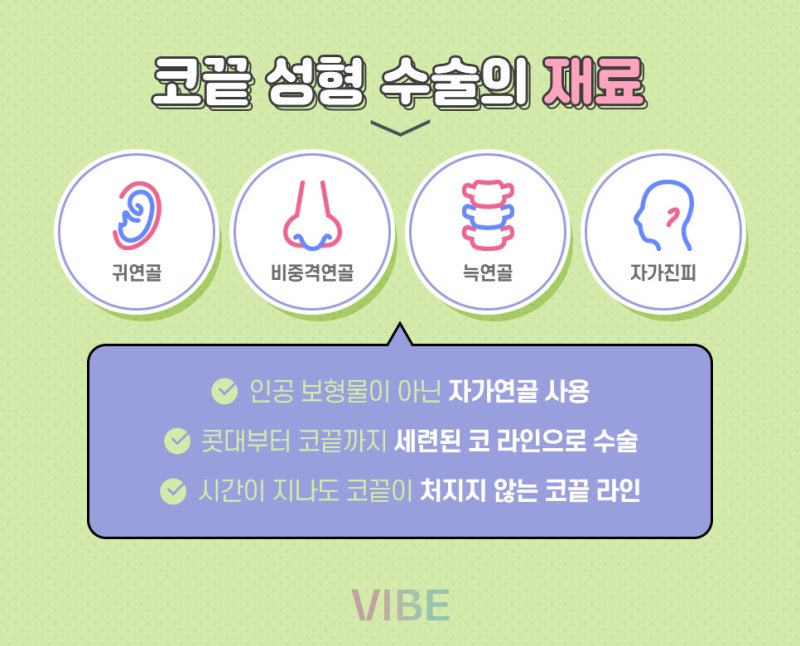
Non-implant rhinoplasty uses autologous tissues.
Generally, septal cartilage harvested from inside your own nose,
ear cartilage that can be harvested from the ear,
rib cartilage harvested from the rib area,
and autologous dermis harvested from the buttocks or behind the ear
are used for this purpose.
Ear Cartilage
Ear cartilage has characteristics very similar to the nasal tip cartilage,
making it the most suitable for creating a natural-looking nasal tip.
And because it is harvested from a location with almost no functional role,
specifically the innermost part behind the ear,
it does not place a significant burden on the body.
Furthermore, not only does it create a natural shape,
but its movement is also natural, giving a feel similar to your original nose,
and it is a highly preferred autologous tissue
because it can minimize any artificial appearance.
Septal Cartilage
Septal cartilage is the cartilage located in the center of the inside of the nose.
Because it is harvested from inside the nose,
it does not require a separate incision in another area of the body.
However, the amount of septal cartilage that can be harvested varies from person to person,
so if it is difficult to harvest a sufficient amount,
additional artificial implants may be necessary.
Therefore, when using this autologous tissue, you must make a decision
after a thorough consultation with a board-certified plastic surgeon.
Rib Cartilage
After making a 1.5 to 2 cm incision on the side of the ribs,
about 3 to 4 cm of the inner cartilage is harvested and used.
Due to its high support and durability, it is mainly used to extend the columella
or to shape the nose,
and is utilized for flat noses, short noses, and revision surgeries.
Rib cartilage is broadly divided into
autologous rib cartilage and donated rib cartilage.
Autologous rib cartilage literally means
using your own rib cartilage,
while donated rib cartilage refers to rib cartilage received from a donor.
After harvesting the rib cartilage from a human body,
it undergoes sufficient chemical processing
to become a processed material safe for insertion into the human body.
Why Choose Vibe for Non-Implant Rhinoplasty?
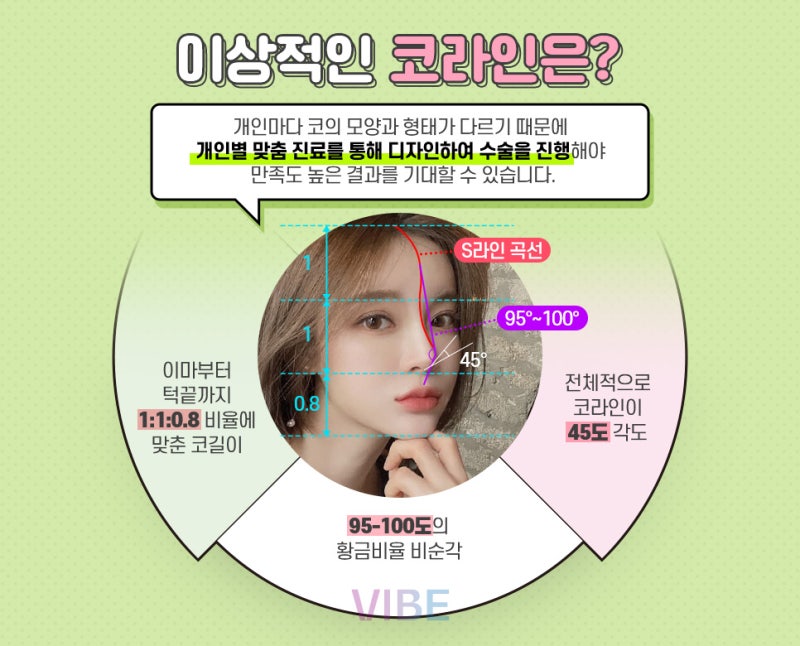
✔ Precise analysis and examination conducted through 3D-CT
✔ Surgical planning based on your desired nose shape
✔ Resolving functional issues such as nasal congestion,
deviated septum, and nasal valve collapse
✔ A nasal tip line with fewer side effects that does not droop over time
Vibe harvests natural cartilage and finely sculpts it
to form a high and natural-looking nasal bridge line.
The nasal tip does not droop over time,
and with fewer side effects, the results can be maintained for a long time.

Because the results of rhinoplasty can vary depending on the materials used,
careful decision-making is required.
In the case of non-implant rhinoplasty, since only autologous tissues are used,
the surgical plan must be established after checking not only the condition of the nose before surgery
but also the condition of the cartilage.
Therefore, if you are considering non-implant rhinoplasty, we recommend
checking whether the clinic is equipped with devices like 3D-CT
and whether the medical staff has abundant clinical experience
before making your decision.





Frequently Asked Questions
What is non-implant rhinoplasty?
Non-implant rhinoplasty is a surgical procedure that improves the shape of the nose using only the patient's own autologous tissues instead of artificial implants. It primarily uses septal cartilage, ear cartilage, rib cartilage, and autologous dermis, offering the advantage of fewer side effects compared to artificial implants.
What are the advantages of using ear cartilage in rhinoplasty?
The biggest advantage is that the shape and movement are very natural, just like the original nose. Its characteristics are similar to those of the nasal tip cartilage, and it is harvested from the inner part behind the ear, which has no functional role, thus minimizing physical burden and artificial feel.
Where is septal cartilage harvested from, and what should be noted?
It is harvested from the center of the nose, so no separate external incision is required. However, the amount of cartilage that can be harvested varies from person to person, so if it is not sufficient, additional material may be needed; therefore, thorough consultation with a specialist before surgery is necessary.
In what cases is rib cartilage mainly used?
It is mainly used to extend a low or short nose, and to build up the columella during revision surgery. It has very high support and durability, and you can choose between autologous rib cartilage (your own cartilage) and processed donated rib cartilage.
Can non-implant rhinoplasty also solve functional problems like nasal congestion?
Yes, it is possible. Through 3D-CT precise analysis, internal functional problems of the nose such as nasal congestion, deviated septum, and nasal valve stenosis can be identified and treated along with cosmetic improvement of the nose shape.