2026-05-25
An In-Depth Analysis of the Various Types of Double Eyelid Surgery!
Hello. This is Vibe Plastic Surgery. Although we live in a society where online and non-face-to-face communication has become more central than meeting and talking eye-to-eye, the eyes still remain one of the most important factors determining our appearance and impression today. As the demand for eyes that can project a clearer, more distinct, and positive image increases, interest in double eyelid surgery is also rising. Double eyelid surgery, ptosis correction, etc. each

Hello.
This is Vibe Plastic Surgery.
Although we live in a society where online and non-face-to-face communication
has become more central than meeting and talking eye-to-eye,
the eyes still remain one of the most important factors
determining our appearance and impression today.
As the demand for eyes that can project
a clearer, more distinct, and positive image increases,
interest in double eyelid surgery is also rising.
Double eyelid surgery, ptosis correction, and other procedures
each have their own purposes and methods of improvement,
and the necessary or appropriate surgical method varies for each individual.
Let's take a look at these various types of double eyelid surgery.

There are largely two types
of double eyelid surgery.
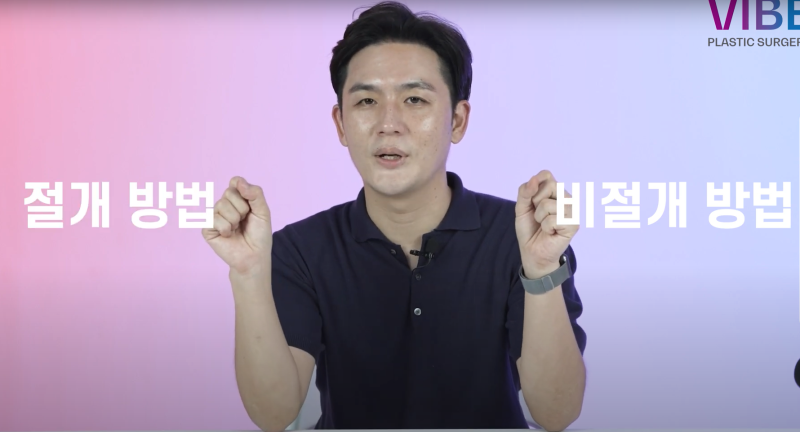
They are divided into incisional and non-incisional methods.
What is the non-incisional method?
The non-incisional method literally means avoiding incisions as much as possible,
so the surgery is performed by only making small punctures.
In the past, this method was also called the suture (burial) method.
Nowadays, the surgery is often performed
using the term natural adhesion.
What is the incisional method?
This is the double eyelid surgery method we commonly know,
created through a skin incision.
Compared to the non-incisional method, the incisional method
has no possibility of the double eyelid line coming undone,
and can achieve a more definitive and distinct line.
“Differences Between the Suture Method VS Natural Adhesion?”
The suture method is one of the surgical techniques
that utilizes small punctures.
It creates a double eyelid using threads,
and because the knots created by those threads are well-buried,
it is referred to as the suture (burial) method.
Natural adhesion is the same in that
the surgery is performed through small punctures.
However, through those small punctures,
a portion of the tissue is removed
to further strengthen the adhesion
and manipulate the area so that the line
can be maintained much better.

“Types & Differences of Incisional Methods”
Partial Incision
The partial incision method falls somewhere in the middle
between the non-incisional method and the full incisional method.
Like most non-incisional methods,
it is performed through small punctures,
but an incision is made only on a small portion.
The reason is that fat can be removed through that area,
and by creating additional adhesion,
it can also play a role in preventing the line from coming undone.
Incisional Method
The incisional method involves making an incision
along the desired double eyelid line, completely removing
underlying tissues or fat,
and directly fixing the line.
Those who are sensitive to scarring
may prefer the non-incisional method even if their eyes require an incision,
while others who have seen people around them get severe scarring
from the incisional method
may want to opt for the suture or natural adhesion method.
Conversely, some people hear cases where the suture or natural adhesion method
came completely undone,
and prefer to get an incision from the very beginning.
Everyone has different preferred surgical methods.

Therefore, focusing on what you prefer—whether it's more important that it doesn't come undone or that there's no scarring—
and considering your own eye condition,
it is best to decide which surgical method will yield the best results
after a thorough consultation with the medical staff.
In the past, when performing the double eyelid incisional method,
there was a time when the goal was simply to prevent it from coming undone.
Back then, the inside was completely cleaned out
and the double eyelid was created by pressing it tightly,
making a firm double eyelid that would never come undone.
Because of this, scarring was a major issue at the time,
but nowadays, there are many surgical techniques that care for scarring
even while performing the incisional method.
As a result, there are no pressed-down scars,
and in many cases, the scarring heals very well,
so you don't have to worry too much about scars.

For the suture method, you can think of the adhesion
being created by a line,
while for the incisional method, it is directly opened to cleanly remove
the tissue inside and fixed using threads,
so you can think of the double eyelid adhesion
being created by a surface.
Because there is a difference in adhesion strength
between something created by a line
and something created entirely by a surface,
there is a perception that the incisional method
is less likely to come undone and lasts longer.
However, even with the suture method,
if your eyes are a good case for it,
good adhesion is created,
so there are cases where you don't have to worry about it coming undone.
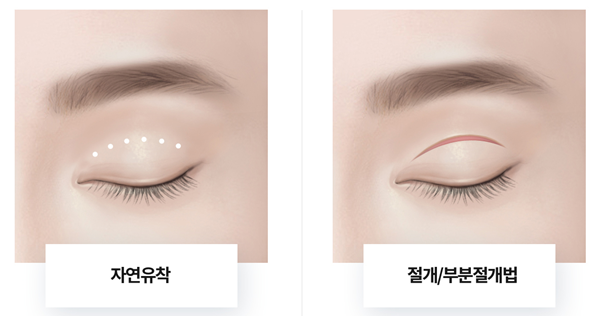
“Natural Adhesion (Suture) VS Incision, Partial Incision Check by Case”
Natural Adhesion (Suture) Types
- When the eyelids are thin and have little sagging
- When a natural double eyelid line is desired
- When there is little eyelid fat
- When a quick recovery is desired
Incisional Method Types
- When the eyelid skin is thick and has a lot of fat
- When there is severe sagging of the eyelid skin
- When revision eye surgery is needed
- When ptosis symptoms are moderate to severe
As such, because there are various eye types
and surgical methods for double eyelid surgery,
you must plan an appropriate double eyelid surgery method
for your individual eye structure and condition,
based on the precise diagnostic know-how of medical staff
who possess extensive surgical experience.
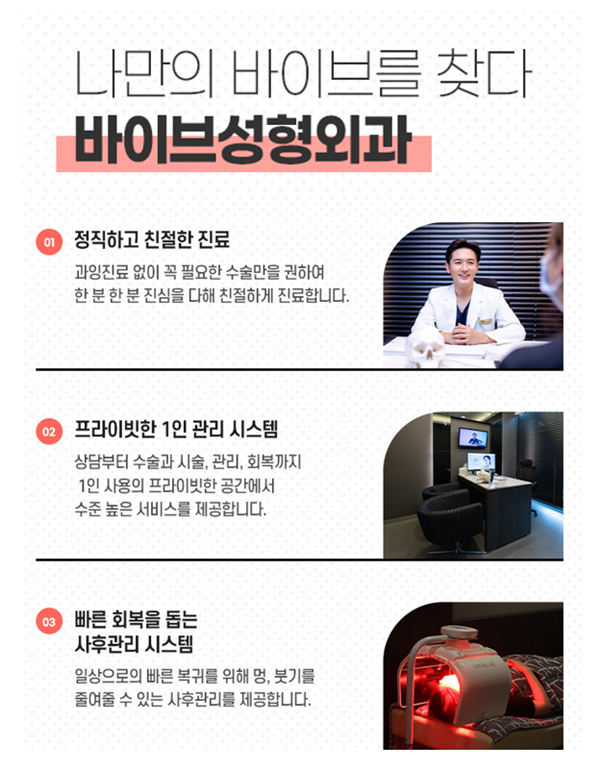
Vibe Plastic Surgery operates
a 1:1 dedicated system with board-certified plastic surgeons
who possess abundant know-how!
CCTVs are installed everywhere, including operating rooms, consultation rooms, and recovery rooms!
A private 1-on-1 care system!
An aftercare system to help with quick recovery!





Frequently Asked Questions
What is the difference between the buried suture method and natural adhesion?
Both methods involve surgery through small incisions, but they differ in whether tissue is removed. The buried suture method creates double eyelids using a knot of thread, while natural adhesion involves removing some tissue through the incision to strengthen the adhesion and help the line maintain itself better.
Will incisional surgery leave severe scars?
No, you can significantly reduce concerns about scars nowadays. In the past, strong fixation to prevent loosening often resulted in scars, but modern surgical techniques for incisional methods have advanced to minimize scarring, allowing for natural results without noticeable scars.
What type of eyes are suitable for natural adhesion (non-incisional) surgery?
It is most suitable for eyes with thin eyelids and minimal sagging or fat. This surgical method is also recommended for those who desire a natural double eyelid line or expect a quick recovery after surgery. If your eye condition is good, you can achieve strong, long-lasting adhesion even with the non-incisional method.
What surgery should I get if my eyelids are thick and have a lot of fat?
The incisional method is recommended. If your eyelid skin is thick, has a lot of fat, severe skin sagging, or moderate to severe ptosis, the incisional method is suitable. Incision allows for the clean removal of unnecessary tissue and fat, creating adhesion over a wider area to reduce the possibility of the double eyelid line loosening.