2026-05-25
Reasons for Using Donated or Autologous Rib Cartilage in Rhinoplasty!
Hello. This is Vibe Plastic Surgery. Recently, due to psychological anxiety and side effects regarding nasal implant insertion, many of you might be curious about autologous rib cartilage and donated rib cartilage, which are methods to perform surgery without using them. We will inform you about everything you might be curious about, such as where the rib cartilage is located and why it is used. Rib cartilage refers to the cartilage of the ribs. In our body...

Hello.
This is Vibe Plastic Surgery.
Recently, regarding nasal implant insertion,
due to psychological anxiety and side effects,
methods to perform surgery without using them,
such as autologous rib cartilage and donated rib cartilage,
are something many of you might be curious about.

Where the rib cartilage is located,
what the reasons for using it are, and more—
we will inform you about everything
you might be curious about.

Rib cartilage refers to the cartilage of the ribs.
In our body, to protect important structures
such as the lungs and heart, rib cartilage
is located in the chest area.
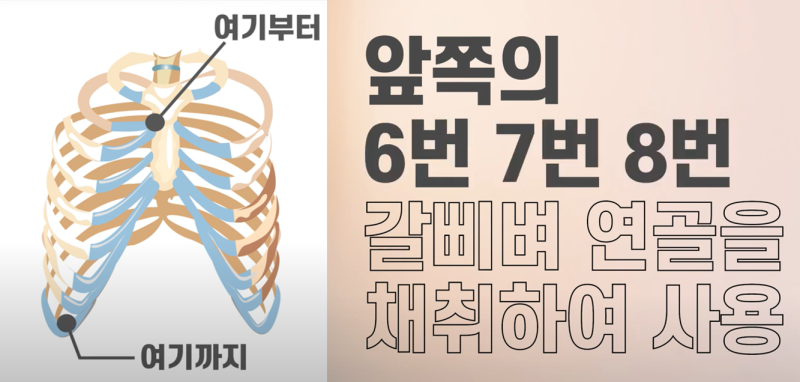
As shown in the picture, from the center to the very bottom,
it is composed of rib cartilage,
and it consists of bone as it goes outward.
Therefore, during rhinoplasty, the 6th, 7th, and 8th
rib cartilages at the front are usually harvested and used.

However, for those who are afraid of using their own autologous rib cartilage,
and those who feel burdened by the fact that a small scar
of about 2.5cm to 3cm will be left behind,
in such cases, rib cartilage harvested from a cadaver
that has undergone complete immunological processing,
known as donated rib cartilage, is also used as a material.

The characteristics of rib cartilage are that it is large, hard, and strong.
Because of this, using rib cartilage during rhinoplasty
is the best way to achieve a shape
that feels sharp and straight.
The first choices are usually septal and ear cartilage.
The reason is that harvesting cartilage within the surgical field
is much more comfortable for the patient undergoing surgery,
causes less pain, and allows for a faster recovery to daily life.
However, there are cases where rib cartilage is truly necessary.
If the septal and ear cartilages are too thin and weak,
or if they have already been used in a previous surgery,
I believe rib cartilage must naturally be used.

Often, the nose is small, bulbous, and lacks support, but a jikban (straight-curve) line
with a slightly high and sharp shape is desired.
In these cases, rib cartilage must be used
to expect a high level of satisfaction.

Rib cartilage has a curved shape, not a straight line.
As a result, the smaller it is cut, the more a warping phenomenon—
that is, the cartilage itself bending slightly—can occur.
Even if it looked quite straight during the surgery and was used,
if it bends over time,
it can cause the side effect of the nose inevitably
bending to one side.
Also, compared to other cartilages,
because rib cartilage is harder,
it has a disadvantage in terms of tactile feel.
Although there are concerns for these reasons,
I do not think it is a material
that should never be used.

When performing rhinoplasty, the most important thing not to miss
is the functional aspect, in my opinion.
Since the nose is ultimately a structure for breathing,
even if the shape is pretty,
if breathing is uncomfortable and difficult,
it is better to avoid that method.
Therefore, during rhinoplasty, do not only focus on the shape of the nose,
but also consider the functional aspects together
to select the appropriate type of cartilage.

It is difficult to definitively say
that rib cartilage is simply good or bad.
If used well according to necessity,
it is a material that can be a very good choice, so
if you are having difficulty choosing materials for rhinoplasty,
please visit Vibe Plastic Surgery
for a precise diagnosis through 3D-CT
to improve both functional
and aesthetic aspects together.





Frequently Asked Questions
What part of the body's cartilage is costal cartilage?
Costal cartilage refers to rib cartilage. The rib cartilage, which protects important structures such as the lungs and heart in our body, is located in the chest area, and typically, the 6th, 7th, and 8th rib cartilages from the front are harvested and used for rhinoplasty.
What is the main reason for using costal cartilage in rhinoplasty?
Costal cartilage is large, firm, and strong. Due to these characteristics, using costal cartilage in rhinoplasty is most effective for creating a nose shape that appears tall and straight.
Can scars remain after harvesting autologous costal cartilage?
Yes, a scar of about 2.5cm to 3cm can remain after harvesting autologous costal cartilage. If this scar is a concern, there is also an option to use donor costal cartilage material that has undergone immunological processing.
What are the possible side effects or disadvantages of using costal cartilage?
Costal cartilage can warp (Warping) when cut into smaller pieces, causing the nose to become crooked over time. Additionally, it is harder than other cartilages, which can be a disadvantage in terms of tactile feel.
When is costal cartilage used instead of septal or ear cartilage?
Costal cartilage is used when the septal and ear cartilages are too thin and weak, or have already been used. High satisfaction can be expected, especially if the nose is small, blunt, and lacks strength, but a tall and sharp nose is desired.
What is the most important consideration when choosing rhinoplasty materials?
Considering the functional aspect is crucial. The nose is a breathing structure, so if it's difficult to breathe even if the shape is beautiful, it's best to avoid it. Both aesthetics and function must be considered.