2026-05-25
Revision Rhinoplasty: A Decision That Requires Careful Consideration
Hello. This is Vibe Plastic Surgery. The nose is located in the exact center of the face, highlighting facial dimensionality and determining the overall impression of the face. The problem is that if a rhinoplasty does not end with the desired results, a revision rhinoplasty must be performed. An even bigger issue is that revision rhinoplasty itself is highly difficult. Since an area that has already been incised must be stimulated again, concerns about secondary complications and additional sca
Hello.
This is Vibe Plastic Surgery.

The nose is located in the exact center of the face,
highlighting facial dimensionality and
determining the overall impression of the face.
The problem is that if a rhinoplasty does not
end with the desired results,
a revision rhinoplasty must be performed.
An even bigger issue is that
revision rhinoplasty itself is highly difficult.
Since an area that has already been incised must be stimulated again,
concerns about secondary complications and additional scarring
are bound to be prominent.

Revision rhinoplasty is
usually performed when the overall tissues have softened
and inflammation has completely subsided,
which is about 6 months after the initial rhinoplasty.
However, if the function or shape of the nose
has severe problems,
early surgery is also possible depending on the medical staff's diagnosis.
In addition, to reduce postoperative recovery time
and minimize tissue damage,
it is important to make limited incisions
and preserve the tissues in their original state.
At Vibe Plastic Surgery,
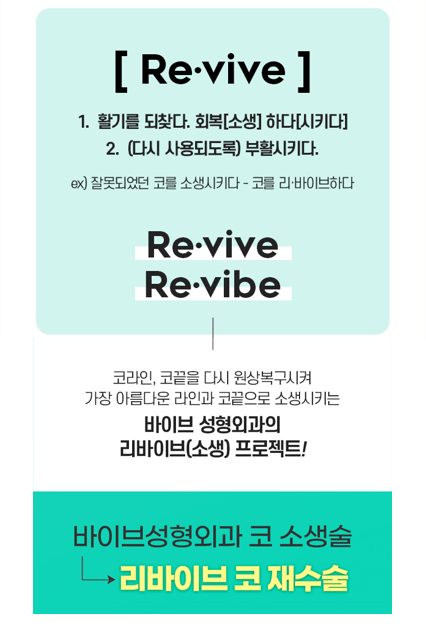
we perform the Revive Revision Rhinoplasty,
that is, restoring the nose line and tip back to their original state
and reviving them into the most beautiful line and tip
through our nasal resuscitation procedure.

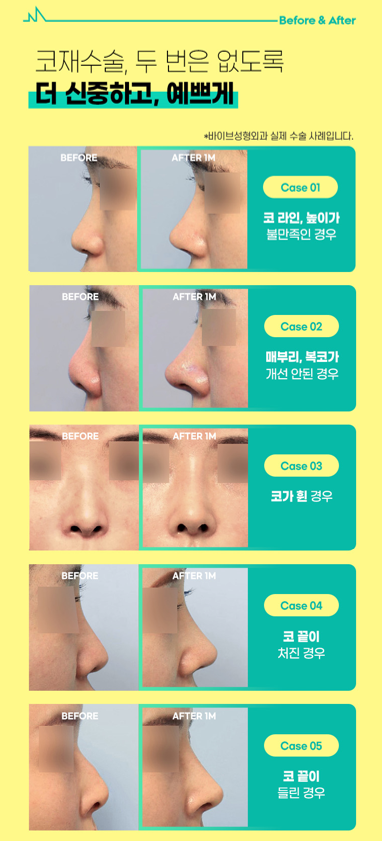
“Why Revision Rhinoplasty?”
If the surgery was performed hastily,
the implant may become unstable or visible through the skin,
and it can lead to side effects such as
a deviated nose, a drooping nasal tip, or dissatisfaction with the line.
If these side effects appear,
they must be corrected through revision rhinoplasty.
While improving the failure factors of the first surgery,
both aesthetic and functional aspects
must be addressed, making the difficulty level even higher.

Revision rhinoplasty
must correct both the shape and structure of the nose.
However, if sufficient consultation and systematic design planning
do not precede the surgery, and revision rhinoplasty is performed simply based on reviews or
costs alone,
there is a constant concern for side effects such as inflammation,
as well as the risk of leading to
decreased satisfaction, so caution is required.
“Vibe's Unique Details for Revision Rhinoplasty”
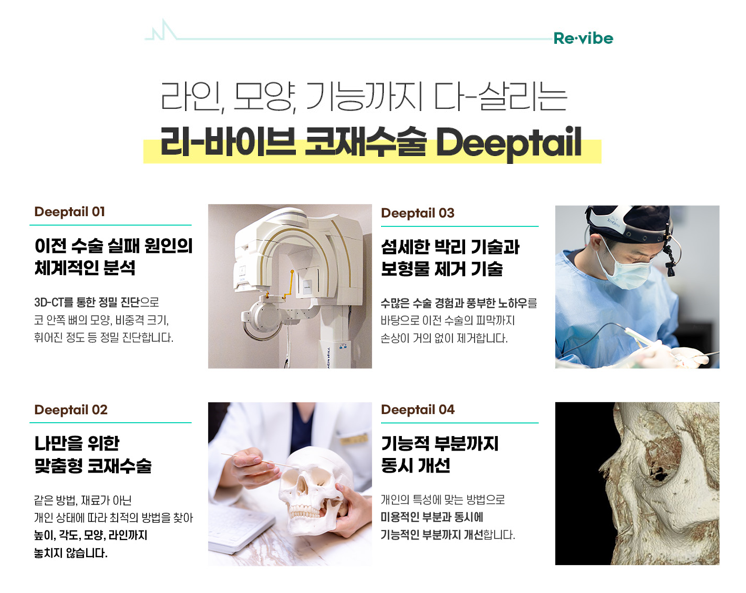
We identify various causes of failure
and perform a precise diagnosis using 3D CT to improve them,
finding the surgical method and materials that suit your nose condition.
In addition, since the presence of side effects, facial features,
and skin and cartilage conditions differ for each individual,
we meticulously consider various factors
and design a nose shape that suits each person,
simultaneously improving both
aesthetic and functional aspects.
For revision rhinoplasty, which utilizes various materials,
autologous tissues such as ear cartilage, septal cartilage, costal cartilage,
autologous dermis, and fascia,
as well as artificial implants like silicone, donated costal cartilage, acellular dermal matrix (ADM),
and Medpor,
depending on each individual's nose condition.
It is important to use them appropriately, and
a 1:1 customized revision rhinoplasty tailored to you
must be performed.
At Vibe Plastic Surgery,
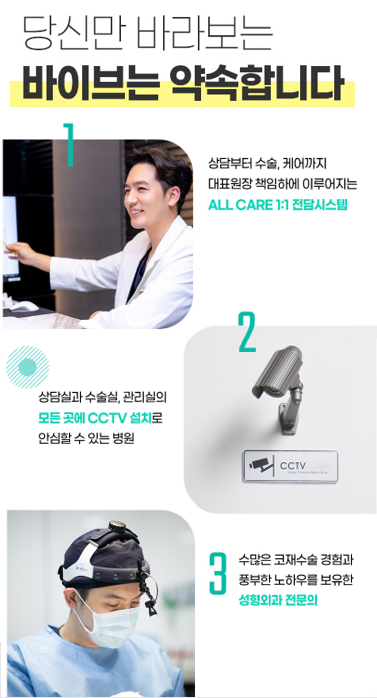
our board-certified plastic surgeon and chief director, who possesses abundant know-how from numerous clinical experiences,
takes charge of the entire process
from the initial consultation to surgery and recovery.
We operate on a 1:1 dedicated system.
In addition, not only are CCTVs installed in
the operating rooms, consultation rooms, and recovery rooms,
but all spaces are also prepared as single private rooms,
so you can use them safely and comfortably
with peace of mind during times like these.





Frequently Asked Questions
When is revision rhinoplasty possible after the initial surgery?
Revision rhinoplasty is usually possible 6 months after the initial surgery. It is best to proceed when the overall tissue has softened and inflammation has completely subsided. However, if there are serious problems with the function or shape of the nose, early surgery may be possible depending on the medical team's diagnosis.
What are the typical side effects that necessitate revision rhinoplasty?
Typical side effects include the implant shaking or being visible through the skin. In addition, revision surgery is considered when problems such as a crooked nose, drooping nasal tip, or dissatisfaction with the line occur, and it is important to improve the failure factors of the initial surgery.
What materials are used for revision rhinoplasty?
Autologous tissues and artificial implants are used appropriately depending on the individual's nose condition. Autologous tissues include ear cartilage, septal cartilage, costal cartilage, and autologous dermis, while artificial implants such as silicone, functional costal cartilage, and allogeneic dermis are used for customized procedures.
How is a precise diagnosis performed before revision rhinoplasty?
A precise diagnosis is performed using 3D CT equipment. This accurately identifies various causes of failure from previous surgeries and finds the most suitable surgical method and materials for the patient's facial features, skin, and cartilage condition.
Are the operating room and recovery room environments safe?
Yes, they are safely and comfortably designed. CCTV is installed in all spaces, including the operating room, consultation rooms, and recovery rooms, and all spaces are provided as private rooms, so patients can feel at ease and focus on treatment and recovery.