2026-05-25
Revision Rhinoplasty: Why Choose Vibe Plastic Surgery?
Hello. This is Vibe Plastic Surgery. Those who have experienced a failed rhinoplasty naturally have fears about revision surgery. Vibe Plastic Surgery will explain what you should focus on when deciding on revision rhinoplasty. There are various reasons for considering revision rhinoplasty, such as dissatisfaction with the nose line, shape deformation, and nasal inflammation. If you are considering revision rhinoplasty, identifying the cause of failure through accurate analysis...

Hello.
This is Vibe Plastic Surgery.
Those who have experienced a failed rhinoplasty
naturally have fears about revision surgery.
When deciding on revision rhinoplasty,
Vibe Plastic Surgery will explain
what you should focus on.
The reasons for considering revision rhinoplasty
include dissatisfaction with the nose line, shape deformation, nasal inflammation, etc.
There can be various reasons.
If you are considering revision rhinoplasty,
you must identify the cause of the failure through accurate analysis
and perform the surgery tailored to your situation
to lower the probability of side effects occurring.
To achieve safe and satisfactory results,
it is recommended to undergo surgery with a
board-certified plastic surgeon who has extensive experience
and rich anatomical knowledge.

For revision rhinoplasty, it is best to wait until
the damaged tissues from the previous surgery have fully recovered.
Only then can you achieve satisfactory results
without any side effects.
*We recommend performing the surgery
at least 6 months to 1 year after the primary surgery.
Why Choose Vibe Plastic Surgery for Revision Rhinoplasty?
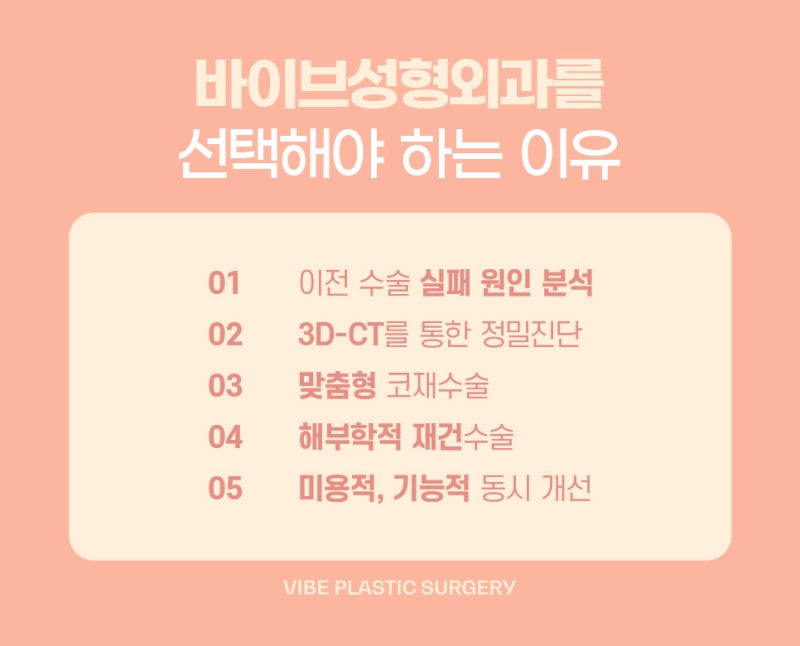
In the case of revision rhinoplasty,
precise diagnosis through 3D-CT
and analysis of the cause of the previous failure are necessary
to ensure there are no further failures.
Vibe Plastic Surgery
not only conducts precise cause analysis using 3D-CT
but also adheres to the principle of customized revision rhinoplasty
tailored to your individual face.
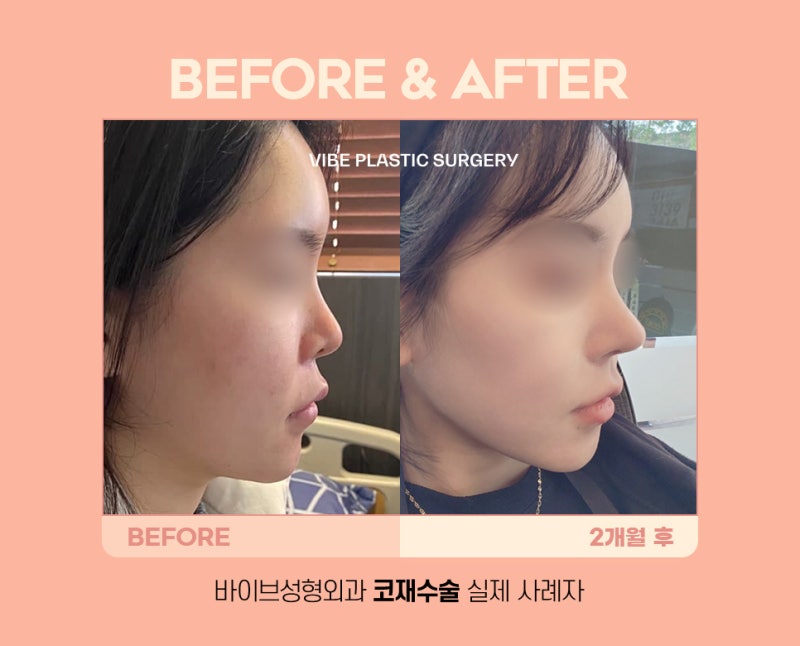
This is an actual revision rhinoplasty patient at Vibe Plastic Surgery, and the surgical plan was:
#RevisionRhinoplasty #NasalBridge(Implant) #NasalTip(AutologousCostalCartilage)
#DeviatedNose #BulbousNoseCorrection.
What is Autologous Costal Cartilage?
An incision of about 1.5 to 2 cm
is made in the rib area on the side,
and about 3 to 4 cm of the inner cartilage is harvested
to be used during rhinoplasty.
Because it is autologous tissue harvested from your own body,
it has the advantage of a relatively low probability
of side effects such as post-operative inflammation, foreign body reaction,
and shape changes like contracture.
Autologous costal cartilage is widely used
when there is no autologous cartilage (ear cartilage, septum) available due to repeated revisions,
when the nose is small and short,
or when the nose has become shortened due to contracture.
It is highly recommended in such cases.
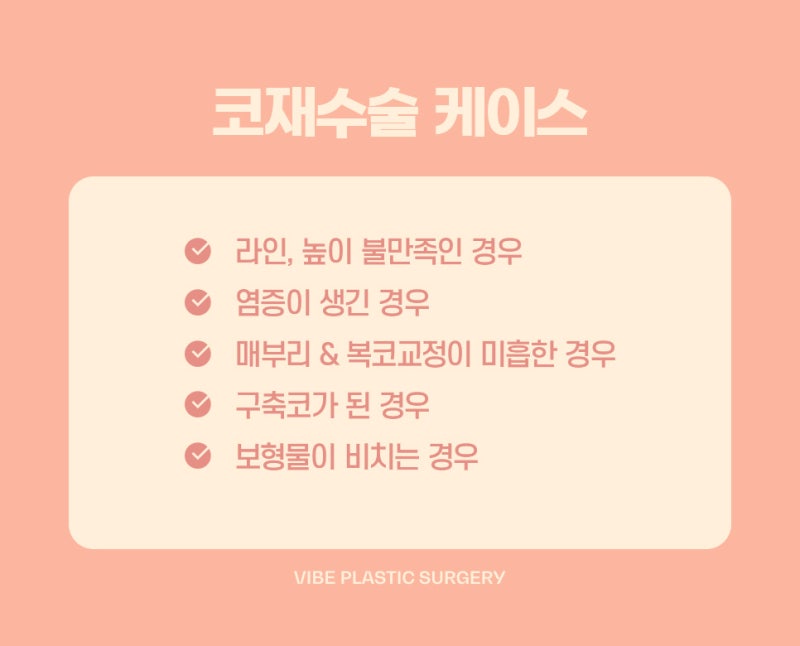
Even for the same revision rhinoplasty case,
the causes can vary depending on conditions
such as the individual's internal nasal structure and skin.
To expect satisfactory results,
a customized surgical plan must be established
before proceeding with the surgery.
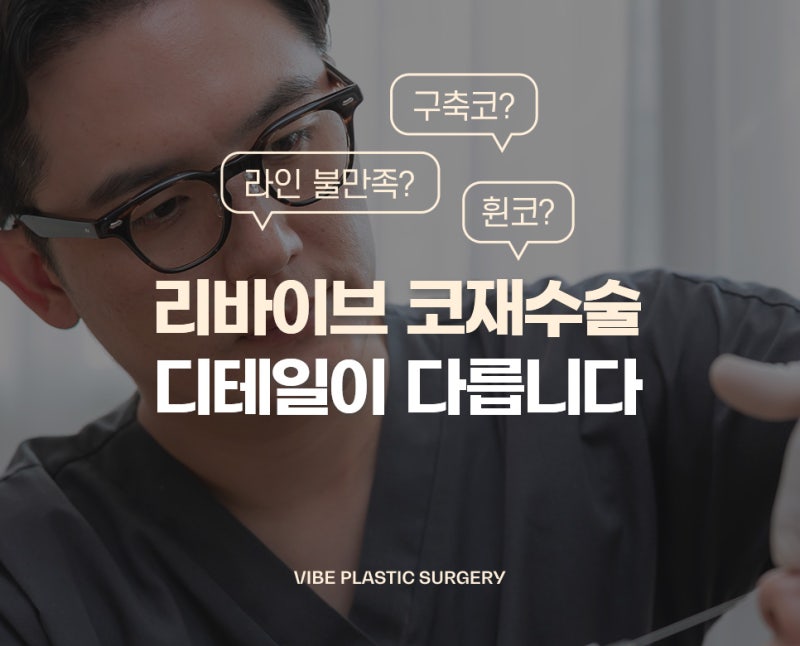
Vibe Plastic Surgery,
true to the name VIBE, does not pursue uniform beauty
but adheres to the principle of natural plastic surgery
that enhances your unique atmosphere and feel.
Dr. Yoo Young-moon, a board-certified plastic surgeon, directly
conducts everything from consultation to surgery,
and provides customized solutions tailored to your face
so you can expect highly satisfactory results.
If you have any further questions about revision rhinoplasty,
please contact our main number at 02-517-4888 or
leave an inquiry in the comments.





Frequently Asked Questions
When is the best time to undergo revision rhinoplasty after the initial surgery?
It is recommended to proceed with revision rhinoplasty at least 6 months to 1 year after the initial surgery. This allows the damaged tissues to fully recover, which helps achieve satisfactory results without side effects.
Is a 3D-CT scan necessary for revision rhinoplasty?
Yes, it is essential. A 3D-CT scan precisely analyzes the causes of failure from previous surgeries and accurately identifies the individual's internal nasal structure, which helps lower the probability of side effects and allows for a successful, customized surgical plan.
What are the advantages of revision rhinoplasty using autologous costal cartilage?
The biggest advantage is that, as it is autologous tissue harvested from the patient's own body, the likelihood of side effects such as inflammation, foreign body reactions, or contracture is relatively low. It is safely used in rhinoplasty after being harvested through a small incision in the side.
In what cases is autologous costal cartilage used?
It is primarily used when there is insufficient autologous cartilage, such as ear cartilage or septal cartilage, due to repeated revision surgeries. It is also very effectively utilized for patients with small and short noses, or those whose noses have shortened due to contracture.
Who conducts the consultation and surgery?
Dr. Yu Young-moon, a board-certified plastic surgeon, personally handles all processes from consultation to surgery. Based on extensive anatomical knowledge and experience, he provides customized solutions that match each individual's unique aesthetic, thereby increasing satisfaction.