2026-05-25
👃🏻 Alar Lowering: What Kind of Nose Needs This Surgery? | Easily Explained by the Famous Plastic Surgery Clinic, Vibe Plastic Surgery
Hello, this is the famous plastic surgery clinic, Vibe Plastic Surgery! When looking in the mirror or taking pictures, there are times when your impression looks somewhat different from the front, and your nose seems short or stuffy. In fact, the degree of nostril (alar) exposure seen from the front often affects your overall impression. Especially if your nostrils stand out when you smile or speak, it is necessary to examine the position and shape of the nostrils together.
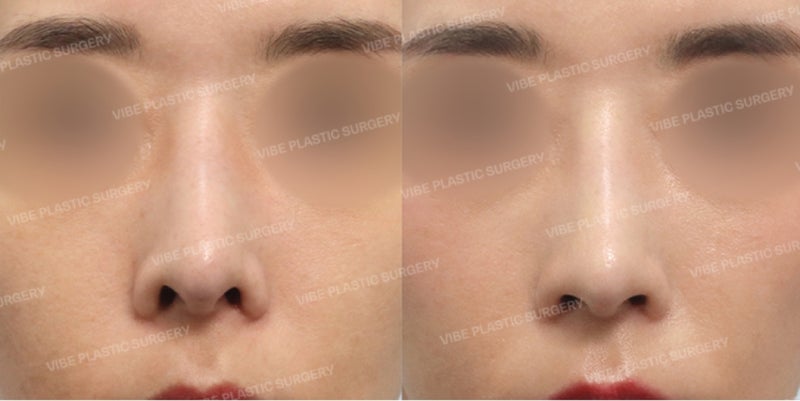

Hello, this is the famous plastic surgery clinic,
Vibe Plastic Surgery!
When looking in the mirror or taking pictures,
you might notice that your impression in frontal photos
looks somewhat different, and your nose appears short
or gives off a stuffy feeling.
In fact, the degree of alar (nostril) exposure seen from the front
often greatly affects your overall impression.
Especially if your nostrils stand out
when you smile or speak, the position and
shape of the alar need to be examined together.
For those who have these concerns,
today we will learn a little more
in detail about alar lowering!📝
What kind of surgery is alar lowering?
👃🏻Simply put, the alar refers to the nostrils.
If you think of the commonly known upturned nose,
it is a shape where the nostrils are highly visible from the front
and the nasal tip is tilted upward.
The "dragon nose," often mentioned in alar lowering,
is also one of the nose shapes with significant nostril exposure from the front.
If you imagine the face of a dragon in cartoons,
you can easily picture large, distinctly emphasized nostrils.
For this similar reason,
🐲the expression 'dragon nose' is used.
Even if the nasal tip is not particularly upturned or droopy, a dragon nose
has the characteristic where the alar rims (the sides of the nose) curl upward,
making the nostrils stand out prominently
from the front.
If the nostrils are highly visible from the front,
the method to improve this is precisely
alar lowering, or dragon nose correction surgery.
How is the alar lowering surgery performed?
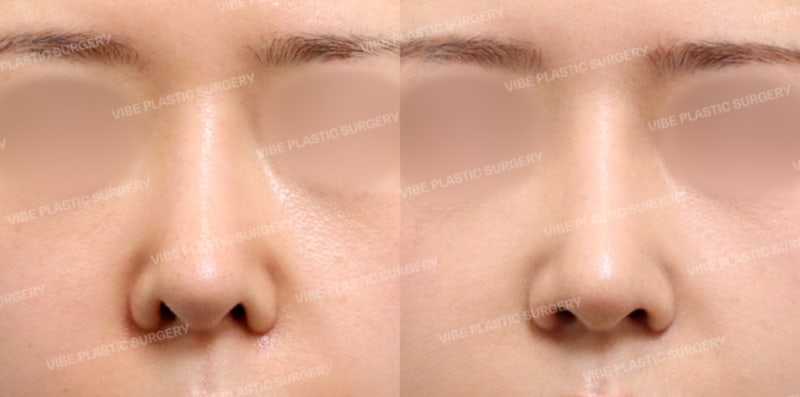
If the alar looks upturned
or the alar rims look pinched,
it may be because the alar cartilages are not sufficiently developed,
or the cartilage was damaged after a previous rhinoplasty.
In such cases, many people come in considering
alar reduction and bulbous nose correction.
If there is a sufficient amount of alar cartilage,
🦴👃🏻it can be improved by repositioning the cartilage to its normal location,
and if the cartilage is insufficient,
cartilage from other areas is grafted
to supplement the shape.
The surgery is performed using an open approach with a columellar incision, or
a closed approach with incisions inside the nostrils,
and the appropriate method is selected based on the individual's nasal structure.
We recommend visiting the famous plastic surgery clinic, Vibe,
to receive an accurate consultation and diagnosis before
making your decision. :)
Who is a Candidate for Alar Lowering?
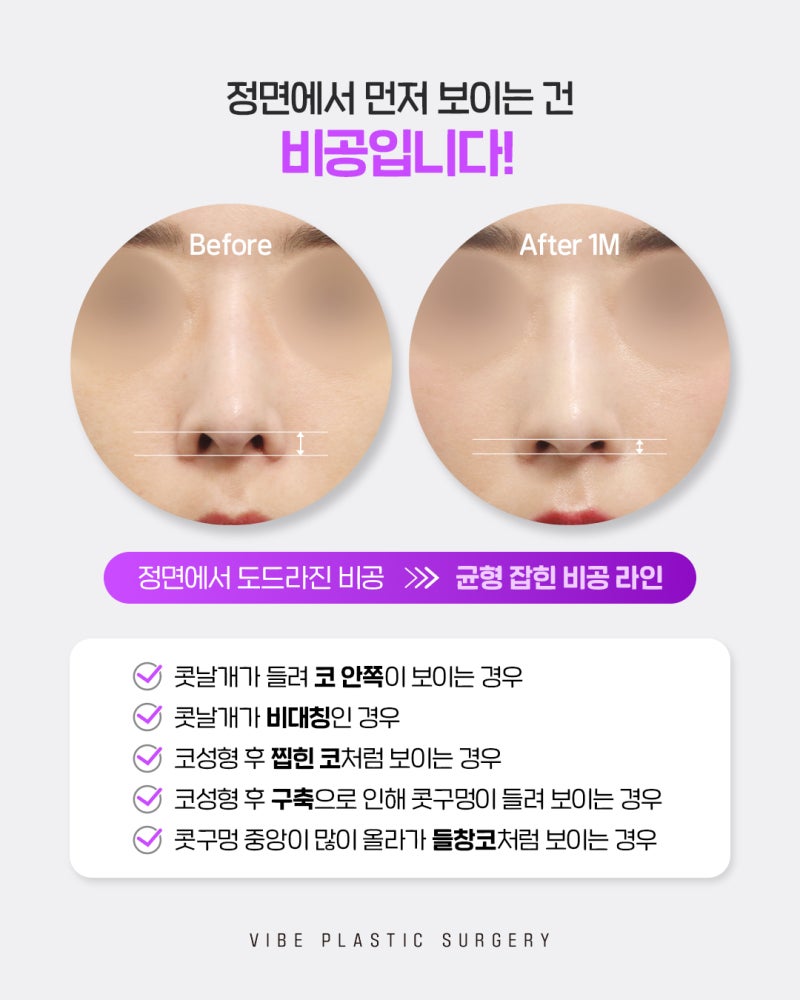
Alar lowering is performed not only for congenital dragon nose correction,
but also when the alar rims look pinched after rhinoplasty,
👃🏻or when the left and right nostrils are asymmetrical.
If the position of the tip cartilage changed during rhinoplasty,
🦴👃🏻or if the cartilage was tied too tightly,
a phenomenon where one or both nostrils look pinched
can occur.
While a congenital dragon nose has upward-curled alar rims
that are close to a circular or oval shape,
a pinched nose that occurs after surgery
is characterized by nostrils that look pointy.
If it is caused by excessively tied cartilage,
🪡it is corrected by releasing the tied area,
and if the nostril exposure is severe,
🦴cartilage or skin is grafted to supplement
the lacking parts.
Since the surgical method varies depending on the condition and cause of the alar,
it is most important to visit the famous plastic surgery clinic, Vibe Plastic Surgery,
and receive a thorough consultation
before proceeding.✨📒
Alar Lowering: The VIBE Point That Makes a Difference

Composite Tissue Graft
(Skin + Ear Cartilage)
Alar lowering at the famous plastic surgery clinic, Vibe,
takes a customized approach depending on the individual's
degree of alar exposure and nasal structure.
At our clinic, we primarily use ear cartilage
to perform alar lowering,
and if the alar exposure is not severe,
an alar rim graft using only cartilage
can provide a natural and satisfactory
improvement in some cases.
On the other hand, if the dragon nose is severe,
👂🏻🦴we may apply a composite tissue graft
that grafts both ear cartilage and skin together.
This is a method where the harvested cartilage and skin
are grafted inside the nostrils to stably
lower the position of the alar.
Most importantly,
it is not about how much it is lowered,
but rather precisely designing only what is necessary
to match the individual's facial balance and nasal structure.
Limitations to Consider During Alar Lowering Surgery
☑️ 100% symmetry is difficult.
Because the thickness of the alar and the elasticity of the soft tissues
vary from person to person, a slight difference between the left and right
may remain even after surgery.
This is an individual difference that occurs within a natural range.
☑️ A fine scar may remain
at the ear cartilage harvest site.
Ear cartilage is primarily harvested through the front of the ear,
and although it is mostly unnoticeable after suturing,
a fine line-shaped scar may remain
when viewed up close.
☑️ The absorption rate of the grafted tissue varies by individual.
A portion of the grafted cartilage and skin may naturally be absorbed
over time, and the degree to which it is maintained
can vary depending on the individual's
tissue condition. :)
As alar lowering surgery can make a big difference
in your impression with just a small change,
it is important to fully understand
the expected scope and limitations
and establish a plan tailored to your individual structure.
For more satisfactory results,
we recommend visiting the famous plastic surgery clinic, Vibe,
to confirm the appropriate surgical direction for you
through an accurate diagnosis and
thorough consultation.☺️




Frequently Asked Questions
In what cases is alar rim lowering surgery necessary?
It is necessary when the nostrils are excessively exposed from the front. This procedure is performed to improve cases such as a congenital 'dragon nose' where the alar rims are rolled upwards, or when the alar rims appear pinched and asymmetrical due to a previous nose surgery.
How is alar rim lowering surgery performed?
It is performed by repositioning or grafting cartilage, depending on the condition of the cartilage. If there is sufficient alar cartilage, it is repositioned to its normal location; if it is insufficient, ear cartilage or skin is grafted to supplement it. For incisions, an appropriate method is chosen between an open approach that opens the columella and a non-open approach that incises the inside of the nostril.
Will there be a scar if ear cartilage is used for surgery?
Yes, a subtle scar may remain. Ear cartilage is usually harvested through the front of the ear, and after suturing, it is mostly unnoticeable, but there is a possibility of a fine linear scar remaining if examined closely.
Is perfect symmetry of the nostrils possible after surgery?
No, achieving 100% perfect symmetry is difficult. Since each person has different nostril thickness and elasticity of soft tissues, there may be slight differences between the left and right sides even after surgery, which is considered a natural individual variation.
Will the grafted cartilage and skin be maintained permanently?
Some of it may naturally absorb over time. The degree of maintenance and absorption rate of grafted tissue varies depending on the individual's tissue condition, so it is important to fully understand these limitations and plan accordingly before surgery.