2026-05-25
Functional Rhinoplasty That Satisfies Both Aesthetic and Functional Aspects, Brought to You by Vibe Plastic Surgery in Nonhyeon-dong :)
Hello! This is Vibe Plastic Surgery :) Many people suffer from allergic or chronic rhinitis. Today, we will talk about how to improve the shape of your nose along with treating rhinitis! We will discuss Nonhyeon functional rhinoplasty. Rhinitis can be broadly divided into allergic rhinitis and rhinitis caused by structural issues, and surgery is combined with oral medication and spray treatments. There are mainly...


Hello! This is Vibe Plastic Surgery :)
Many people suffer from allergic
or chronic rhinitis.
Today, we will talk about how to improve the shape of your nose along with treating rhinitis!
We will be discussing the topic of
Nonhyeon functional rhinoplasty.

Rhinitis can be broadly divided into allergic rhinitis
and rhinitis caused by structural issues,
and surgery is often combined with
oral medications and spray treatments.
There are mainly 3 major causes
for the occurrence of rhinitis.
Rhinitis causes stress for many people,
but what exactly causes it?
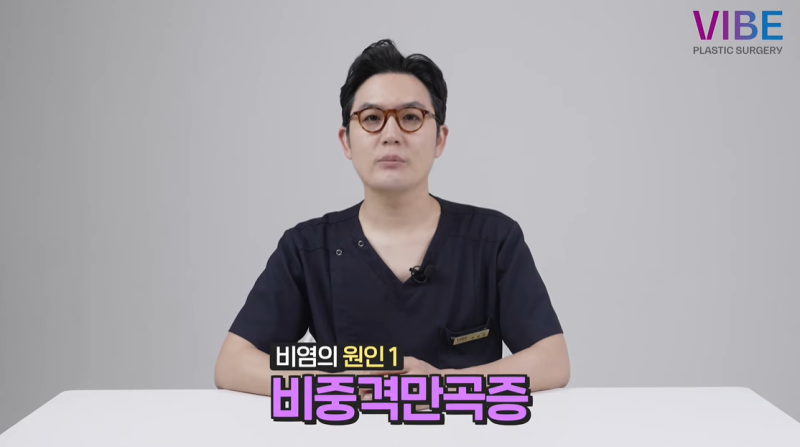
Cause of Rhinitis 1: Deviated Septum
A deviated septum means that the nasal septum
is bent or crooked,
and it can sometimes be curved
in a C-shape or an S-shape.
This can occur congenitally
or be acquired later in life.
A deviated septum can make it difficult to breathe
or cause functional issues like sinusitis,
which can lead to ongoing discomfort in your daily life.

Cause of Rhinitis 2: Nasal Turbinates
The nasal turbinates located inside the nose
play a role in regulating temperature and humidity,
purifying the air, and controlling
the airflow.
They consist of three layers (superior, middle, and inferior turbinates),
and problems generally arise
in the inferior turbinate.
When dry or cold air enters,
blood rushes in to maintain humidity,
causing them to expand. An excessively enlarged
inferior turbinate can obstruct airflow.

Cause of Rhinitis 3: Nasal Valve Collapse
The nasal valve is a very narrow space
located at the top of the internal nasal cavity,
and it is a crucial area for breathing.
Issues with the septal cartilage can cause
the nasal valve passage to narrow,
which can lead to discomfort.
What is Functional Rhinoplasty?
Nose surgery that improves aesthetic aspects
is simply referred to as cosmetic rhinoplasty.
Surgery that corrects the three causes of rhinitis
is said to improve the functional aspects of the nose,
which is why it is called Nonhyeon functional rhinoplasty.

Can Rhinoplasty Be Covered by Insurance?
The most important part when looking into rhinoplasty:
the cost!
Since general rhinoplasty aims only
to improve cosmetic aspects,
it is not covered by insurance, which can
make it financially burdensome.

If there is a functional problem,
insurance coverage may be possible,
but it is not applicable to everyone and has certain conditions.
Symptoms such as nasal congestion, rhinitis, sinusitis, nasal valve collapse,
and a deviated septum must be present
and confirmed visually or symptomatically.
Additionally, an accurate diagnosis by a specialist
using CT scans and nasal endoscopy is required.
Depending on your private health insurance enrollment, provider, and policy,
it is also important to check whether your insurance
covers surgery intended to improve rhinitis symptoms.

In this post, we took some time
to learn about functional rhinoplasty.
Nonhyeon functional rhinoplasty can improve both the functional aspects
and the shape of the nose you've always been concerned about.
As it is a surgery that improves both the inside and outside of the nose,
we hope you choose your clinic carefully
and receive a satisfying surgical outcome :)
Frequently Asked Questions
What is functional rhinoplasty?
Functional rhinoplasty is a surgery that simultaneously addresses aesthetic nasal shape improvement and functional problems of the nose such as rhinitis, deviated septum, and nasal valve stenosis. It can improve both the internal and external aspects of the nose to increase satisfaction.
What are the main causes of rhinitis?
The main causes of rhinitis include a deviated septum, excessively enlarged turbinates inside the nose, and nasal valve stenosis, where the upper nasal passage narrows. Allergic rhinitis is also common.
Is private health insurance applicable for functional rhinoplasty?
Yes, private health insurance may be applicable if functional problems are present. Symptoms such as nasal congestion, rhinitis, sinusitis, deviated septum, or nasal valve stenosis must be visually or diagnostically confirmed, and coverage may vary depending on your insurance policy.
What are the conditions required for private health insurance application?
For private health insurance application, functional symptoms such as nasal congestion and rhinitis must be clear, and an accurate diagnosis by a specialist through CT or nasopharyngeal endoscopy is required. Additionally, you must confirm the coverage details of your insurance company and product.
What is a deviated septum?
A deviated septum refers to a condition where the nasal septum, which divides the nose into left and right, is bent in a C or S shape. This can cause functional problems such as difficulty breathing or sinusitis, leading to discomfort in daily life.
Why does nasal valve stenosis occur?
Nasal valve stenosis is a phenomenon where the nasal valve passage, a narrow space located in the upper part of the nose, narrows due to problems with the septal cartilage. This area plays an important role in breathing, so narrowing can cause discomfort.